Database Selection Framework
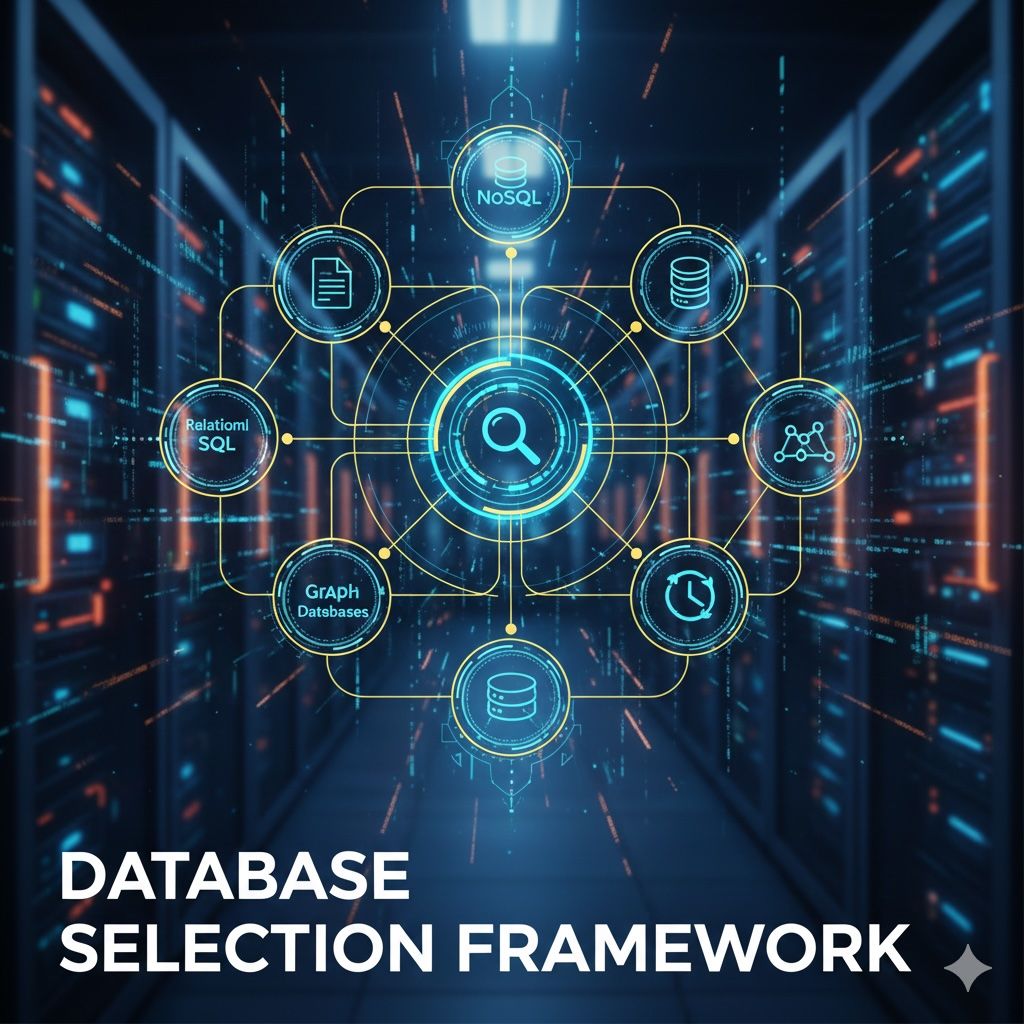
Database Decision Framework
This document summarizes how to choose a database from a solution architecture perspective, covering:
- SQL vs NoSQL
- MySQL vs PostgreSQL
- PostgreSQL JSONB vs MongoDB
- Oracle vs PostgreSQL / SQL Server
- JSON support across major databases
- Licensing & cost considerations
- Why Oracle is expensive and used in banking
1. SQL vs NoSQL – First Decision
Choose SQL when:
- Strong ACID transactions are required
- Complex joins and relationships exist
- Data integrity and constraints matter
- Reporting and analytics are important
- Schema evolution is controlled
Examples:
- Banking systems
- Order & payment systems
- Inventory management
Choose NoSQL when:
- Schema is flexible or evolving fast
- Data is document-oriented or key-value
- Horizontal scalability is a priority
- Eventual consistency is acceptable
Examples:
- User profiles
- Logs and events
- Caching layers
Microservices reduce cross-table joins, but do not eliminate the need for SQL. Each service often still needs strong transactional guarantees.
2. SQL vs NoSQL Feature Comparison
| Feature | SQL | NoSQL | NewSQL (CockroachDB, TiDB) |
|---|---|---|---|
| ACID transactions | ✅ | ⚠️ (limited / scoped) | ✅ |
| Joins | ✅ | ❌ | ✅ |
| Schema enforcement | ✅ | ❌ | ✅ |
| Referential integrity | ✅ | ❌ | ✅ |
| Horizontal scaling | ⚠️ | ✅ | ✅ |
| Flexible schema | ❌ | ✅ | ⚠️ |
| High write throughput | ⚠️ | ✅ | ✅ |
NewSQL databases (CockroachDB, TiDB, YugabyteDB) combine SQL semantics with horizontal scalability. Consider them for globally distributed applications requiring strong consistency.
3. JSON Support Across SQL Databases
Summary Table
| Database | JSON Storage | Native Type | Indexing | Notes |
|---|---|---|---|---|
| PostgreSQL | JSON, JSONB | ✅ JSONB | ✅ GIN | Best JSON support |
| MySQL | JSON | ❌ | ⚠️ Limited | Storage-focused |
| SQL Server | NVARCHAR | ❌ | ⚠️ | JSON as text |
| Oracle (21c+) | JSON | ✅ JSON | ✅ | Enterprise-grade |
4. CAP Theorem & Consistency Models
CAP Theorem
In a distributed system, you can only guarantee two of three:
| Property | Description |
|---|---|
| C - Consistency | All nodes see the same data at the same time |
| A - Availability | Every request receives a response |
| P - Partition Tolerance | System continues operating despite network failures |
Database Classification
| Database | CAP Priority | Consistency Model |
|---|---|---|
| PostgreSQL | CA (single node) | Strong |
| MongoDB | CP (with replication) | Eventual → Strong (configurable) |
| Cassandra | AP | Eventual |
| CockroachDB | CP | Serializable |
| Redis | AP | Eventual |
Tip: For financial/gaming transactions, prefer CP databases with strong consistency.
5. PostgreSQL JSONB vs MongoDB
PostgreSQL JSONB
Strengths:
- Strong ACID transactions
- SQL + JSON in one engine
- GIN indexes for JSON
- Referential integrity
Weaknesses:
- Not optimized for massive document writes
- JSON schema misuse can degrade performance
MongoDB
Strengths:
- Native document database
- Horizontal scaling
- Flexible schema
- Developer-friendly
Weaknesses:
- Weaker joins
- Cross-document transactions are costly
- Eventual consistency patterns
Rule of Thumb
- PostgreSQL JSONB → transactional + hybrid data
- MongoDB → document-first, schema-flexible systems
6. JSONB Anti-Patterns
Avoid using JSONB when:
- JSON contains frequently joined relational data
- You store highly structured data without reason
- You update large JSON blobs frequently
- You use JSONB instead of normalization
Correct usage:
- Optional fields
- Metadata
- Configurations
- Event payloads
7. MySQL vs PostgreSQL – Decision Framework
Choose MySQL when:
- Simple CRUD workloads
- Read-heavy applications
- Operational simplicity is key
- Existing MySQL ecosystem (CMS, LAMP)
Choose PostgreSQL when:
- Complex queries and joins
- High write concurrency
- JSON-heavy workloads
- Microservices
- Data correctness matters
Comparison
| Aspect | MySQL | PostgreSQL |
|---|---|---|
| Ease of use | ⭐⭐⭐⭐ | ⭐⭐⭐ |
| Advanced SQL | ⭐⭐ | ⭐⭐⭐⭐⭐ |
| JSON support | ⭐⭐ | ⭐⭐⭐⭐⭐ |
| Concurrency | ⭐⭐ | ⭐⭐⭐⭐ |
| Extensibility | ⭐⭐ | ⭐⭐⭐⭐⭐ |
If unsure, default to PostgreSQL.
8. Oracle vs PostgreSQL / SQL Server
Why choose Oracle?
- Real Application Clusters (RAC)
- Active-active writes
- Zero-downtime failover
- Flashback (time travel queries)
- Built-in auditing and security
- Long-term vendor support
Why banks use Oracle
- Regulatory compliance
- Zero data loss tolerance
- Predictable query execution
- Vendor accountability (SLAs)
| Feature | Oracle | PostgreSQL |
|---|---|---|
| Active-active cluster | ✅ | ❌ |
| Flashback | ✅ | ❌ |
| Built-in auditing | ✅ | ⚠️ |
| Vendor SLA | ✅ | ❌ |
9. Licensing & Cost
PostgreSQL
- Fully open-source
- Free for production
- No licensing risk
MySQL
- Open-source (GPL v2)
- Free for server-based usage
- Paid only if embedded or redistributed
Oracle
- Commercial license
- Paid per core / feature
- Cost justified by risk reduction
Docker usage:
- PostgreSQL: safe
- MySQL Community: safe
- Oracle: license applies
10. Architecture Rules of Thumb
- Core financial systems → Oracle
- Microservices → PostgreSQL
- Simple web apps → MySQL
- JSON + transactions → PostgreSQL JSONB
- Document-first systems → MongoDB
- Caching / Session storage → Redis
- Time-series / Metrics → TimescaleDB, InfluxDB
- Full-text search → Elasticsearch
- Global distribution + SQL → CockroachDB, TiDB
Database choice is about risk, scale, and correctness, not popularity.
Polyglot Persistence
Modern applications often use multiple databases:
┌─────────────────────────────────────────────────────────┐
│                      Application                        │
├──────────┬──────────┬──────────┬──────────┬────────────┤
│PostgreSQL│  Redis   │ MongoDB  │Elasticsearch│TimescaleDB│
│ (OLTP)   │ (Cache)  │ (Docs)   │ (Search)    │ (Metrics) │
└──────────┴──────────┴──────────┴─────────────┴───────────┘
Example for GameKami:
- PostgreSQL: Users, games, transactions, rooms
- Redis: Session cache, real-time game state, pub/sub
- Elasticsearch: Game history search, player stats (future)
11. Interview-Ready Summary
Quick Answers
Q: SQL vs NoSQL?
"SQL for transactions, relationships, and data integrity. NoSQL for flexible schemas, horizontal scaling, and document-oriented data. Consider NewSQL (CockroachDB) for distributed SQL."
Q: PostgreSQL vs MySQL?
"PostgreSQL for complex queries, JSON support, and write concurrency. MySQL for simple CRUD, read-heavy workloads, and operational simplicity."
Q: Why do banks use Oracle?
"Oracle provides active-active clustering (RAC), zero data loss recovery, flashback queries, and vendor SLAs—critical for regulatory compliance and risk mitigation."
Q: When to use MongoDB?
"Document-first applications with flexible schemas where horizontal scaling matters more than cross-document transactions."
Q: What is CAP theorem?
"In distributed systems, you can only guarantee two of three: Consistency, Availability, Partition Tolerance. PostgreSQL prioritizes CA, MongoDB is CP, Cassandra is AP."
Last updated: February 2026

Duong Ngo
Full-Stack AI Developer with 12+ years of experience