Flask vs FastAPI vs Django
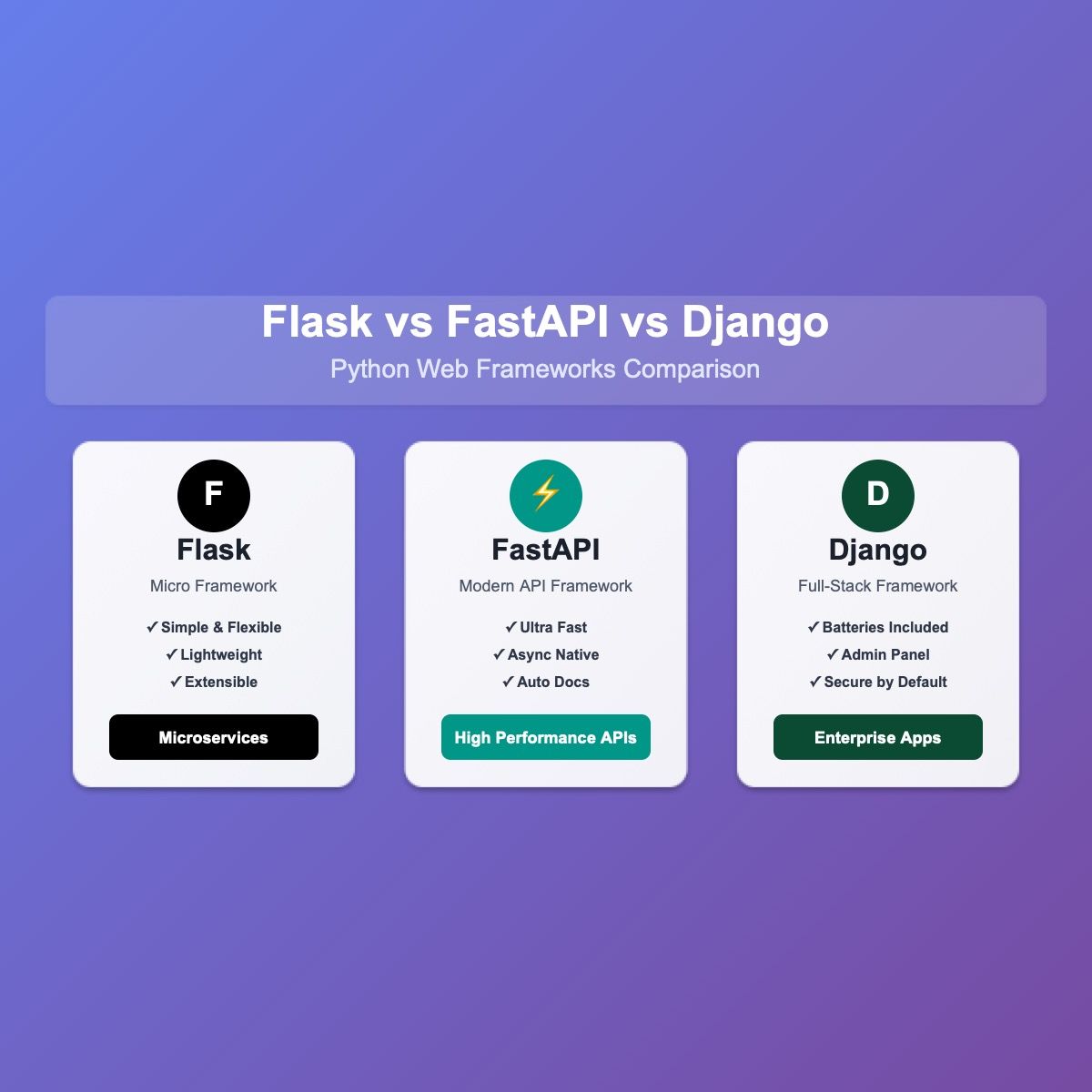
Flask vs FastAPI vs Django: A Comprehensive Comparison
Introduction
Python offers three powerful web frameworks, each designed with different philosophies and use cases in mind. This guide will help you choose the right framework for your project by comparing Flask, FastAPI, and Django across multiple dimensions.
Quick Overview
| Feature | Flask | FastAPI | Django |
|---|---|---|---|
| Type | Micro-framework | Modern API framework | Full-stack framework |
| Release Year | 2010 | 2018 | 2005 |
| Philosophy | Minimalist, flexible | Fast, modern, async | Batteries-included |
| Learning Curve | Easy | Moderate | Steep |
| Performance | Good | Excellent | Good |
| Async Support | Limited (via extensions) | Native | Native (3.1+) |
Flask
What is Flask?
Flask is a lightweight, micro-framework that provides the essentials for web development without imposing a specific structure or dependencies. It follows the WSGI standard and is known for its simplicity and flexibility.
Use Cases
- Small to medium-sized applications
- Prototypes and MVPs
- RESTful APIs with simple requirements
- Projects requiring maximum flexibility
- Microservices architecture
- Learning web development basics
Pros
✅ Simple and Easy to Learn: Minimal boilerplate, perfect for beginners
✅ Highly Flexible: Choose your own tools, databases, and architecture
✅ Extensive Ecosystem: Thousands of extensions available (Flask-SQLAlchemy, Flask-Login, etc.)
✅ Great Documentation: Well-documented with many tutorials and resources
✅ Lightweight: Minimal overhead, fast to get started
✅ Mature and Stable: 15+ years of development and community support
✅ Perfect for Microservices: Small footprint ideal for containerized deployments
Cons
❌ Manual Setup Required: Need to configure most features yourself
❌ No Built-in Admin Panel: Must build or integrate third-party solutions
❌ Limited Async Support: Not built with async/await in mind
❌ More Boilerplate for Large Apps: Can become complex as projects grow
❌ No Built-in ORM: Need to integrate SQLAlchemy or other ORMs
❌ Security Features Not Built-in: Must manually implement CSRF protection, etc.
Code Example
from flask import Flask, jsonify, request

app = Flask(__name__)

@app.route('/api/users', methods=['GET'])
def get_users():
    users = [
        {"id": 1, "name": "John Doe"},
        {"id": 2, "name": "Jane Smith"}
    ]
    return jsonify(users)

@app.route('/api/users', methods=['POST'])
def create_user():
    data = request.get_json()
    return jsonify({"message": "User created", "data": data}), 201

if __name__ == '__main__':
    app.run(debug=True)
FastAPI
What is FastAPI?
FastAPI is a modern, high-performance web framework built on top of Starlette and Pydantic. It's designed specifically for building APIs with Python 3.7+ type hints and provides automatic API documentation, data validation, and serialization.
Use Cases
- High-performance RESTful APIs
- Machine Learning model serving
- Real-time applications (WebSockets)
- Microservices requiring high throughput
- Projects leveraging async/await
- APIs requiring automatic documentation
- Data validation-heavy applications
Pros
✅ Blazing Fast Performance: One of the fastest Python frameworks (comparable to Node.js and Go)
✅ Automatic API Documentation: Built-in Swagger UI and ReDoc
✅ Type Hints and Validation: Leverages Python type hints with Pydantic for automatic validation
✅ Native Async Support: Built on ASGI, fully supports async/await
✅ Modern Python Features: Designed for Python 3.7+ with modern syntax
✅ Developer Experience: Excellent autocomplete and error detection in IDEs
✅ Less Code: Reduces code duplication by ~40% compared to alternatives
✅ Production Ready: Used by Microsoft, Uber, Netflix
Cons
❌ Younger Ecosystem: Fewer extensions compared to Flask/Django
❌ Learning Curve: Requires understanding of async programming and type hints
❌ Not Full-Stack: Focused on APIs, not traditional web applications
❌ Limited Template Support: Not designed for server-side rendering
❌ Smaller Community: Less Stack Overflow answers and tutorials (but growing rapidly)
Code Example
from fastapi import FastAPI
from pydantic import BaseModel
from typing import List

app = FastAPI()

class User(BaseModel):
    id: int
    name: str
    email: str

users_db = [
    User(id=1, name="John Doe", email="john@example.com"),
    User(id=2, name="Jane Smith", email="jane@example.com")
]

@app.get("/api/users", response_model=List[User])
async def get_users():
    return users_db

@app.post("/api/users", response_model=User, status_code=201)
async def create_user(user: User):
    users_db.append(user)
    return user

@app.get("/api/users/{user_id}", response_model=User)
async def get_user(user_id: int):
    return next((u for u in users_db if u.id == user_id), None)
Django
What is Django?
Django is a high-level, full-stack web framework that follows the "batteries-included" philosophy. It provides everything needed to build complete web applications, including an ORM, admin panel, authentication, and more.
Use Cases
- Content Management Systems (CMS)
- E-commerce platforms
- Social networks and community platforms
- Enterprise applications
- Projects requiring rapid development
- Applications with complex database relationships
- When you need a full-featured admin panel out of the box
Pros
✅ Batteries Included: ORM, admin panel, authentication, migrations all built-in
✅ Powerful Admin Interface: Automatically generated, customizable admin panel
✅ Security First: Built-in protection against CSRF, SQL injection, XSS, clickjacking
✅ Django ORM: Powerful, intuitive database abstraction layer
✅ Scalability: Powers Instagram, Pinterest, Mozilla, and other large platforms
✅ Mature Ecosystem: Thousands of third-party packages
✅ Great for MVPs: Get a full application running quickly
✅ Excellent Documentation: Comprehensive and well-organized
Cons
❌ Monolithic Structure: Opinionated structure can feel restrictive
❌ Steep Learning Curve: Lots to learn for beginners
❌ Overhead for Simple APIs: Too heavy for simple REST APIs
❌ Performance: Slower than Flask/FastAPI for API-only applications
❌ Not Microservices Friendly: Better suited for monolithic applications
❌ Template System: While powerful, may be unnecessary for API-only projects
❌ Async Support: Only recently added, ecosystem still catching up
Code Example
# models.py
from django.db import models

class User(models.Model):
    name = models.CharField(max_length=100)
    email = models.EmailField(unique=True)
    created_at = models.DateTimeField(auto_now_add=True)

    def __str__(self):
        return self.name

# views.py
from rest_framework import viewsets
from .models import User
from .serializers import UserSerializer

class UserViewSet(viewsets.ModelViewSet):
    queryset = User.objects.all()
    serializer_class = UserSerializer

# serializers.py
from rest_framework import serializers
from .models import User

class UserSerializer(serializers.ModelSerializer):
    class Meta:
        model = User
        fields = ['id', 'name', 'email', 'created_at']

# urls.py
from django.urls import path, include
from rest_framework.routers import DefaultRouter
from .views import UserViewSet

router = DefaultRouter()
router.register(r'users', UserViewSet)

urlpatterns = [
    path('api/', include(router.urls)),
]
Performance Comparison
Based on benchmarks for handling JSON APIs:
| Framework | Requests/sec | Latency (ms) | Relative Speed |
|---|---|---|---|
| FastAPI | ~20,000 | ~5 | 1.0x (baseline) |
| Flask | ~8,000 | ~12 | 0.4x |
| Django | ~6,000 | ~15 | 0.3x |
Note: Actual performance varies based on implementation, database queries, and server configuration
Decision Matrix
Choose Flask if:
- 🎯 You need maximum flexibility and control
- 🎯 Building a small to medium-sized application
- 🎯 Creating a simple REST API without complex validation
- 🎯 Want to learn web development fundamentals
- 🎯 Need to integrate with specific libraries or tools
- 🎯 Building microservices with minimal overhead
Choose FastAPI if:
- 🎯 Performance is critical
- 🎯 Building modern APIs with automatic documentation
- 🎯 Need strong data validation and serialization
- 🎯 Working with async/await and concurrent operations
- 🎯 Want excellent IDE support with type hints
- 🎯 Serving machine learning models
- 🎯 Building real-time applications with WebSockets
Choose Django if:
- 🎯 Building a full-featured web application
- 🎯 Need an admin panel and authentication out of the box
- 🎯 Working with complex database relationships
- 🎯 Security is a top priority
- 🎯 Need to build quickly with proven patterns
- 🎯 Building a CMS, e-commerce site, or social platform
- 🎯 Want a complete, opinionated framework
Real-World Usage
Companies Using Flask
- Pinterest (initially)
- LinkedIn (some services)
- Twilio
- Red Hat
Companies Using FastAPI
- Microsoft (several teams)
- Uber
- Netflix (ML inference services)
- Explosion.ai (spaCy API)
Companies Using Django
- Mozilla
- Spotify
- Dropbox
- The Washington Post
Migration Considerations
From Flask to FastAPI
- ✅ Similar decorator-based routing
- ✅ Easy to adapt existing Flask patterns
- ⚠️ Need to add type hints
- ⚠️ Convert synchronous code to async
From Django to FastAPI
- ⚠️ Significant rewrite required
- ⚠️ Lose built-in admin panel
- ⚠️ Need to choose ORM (or use Django ORM separately)
- ✅ Gain performance improvements
- ✅ Better for API-only applications
From Flask to Django
- ⚠️ Major restructuring required
- ✅ Gain built-in features
- ⚠️ Need to adopt Django conventions
- ⚠️ More opinionated architecture
Conclusion
There's no universal "best" framework—the right choice depends on your specific needs:
- Flask excels in flexibility and simplicity
- FastAPI dominates in performance and modern API development
- Django wins for full-featured web applications with rapid development needs
For most new API projects in 2025, FastAPI is the recommended choice due to its performance, modern features, and excellent developer experience. For traditional web applications with admin needs, Django remains the gold standard. Flask continues to be perfect for projects requiring maximum flexibility or when you're learning web development.
Further Resources
Flask
FastAPI
Django
Last Updated: December 2025

Duong Ngo
Full-Stack AI Developer with 12+ years of experience